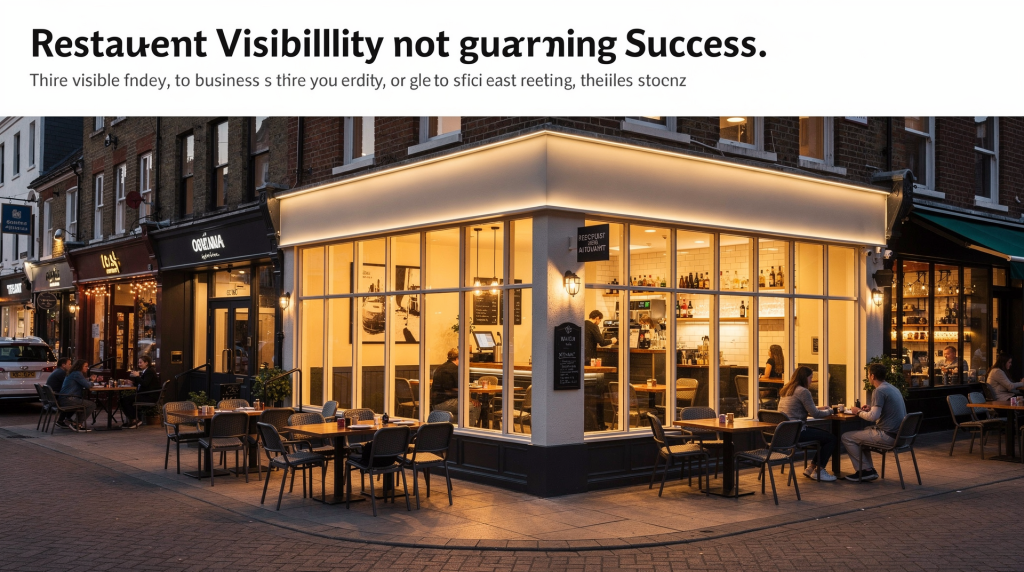
A restaurant can be easy to spot and still struggle to fill seats. Visibility helps people notice you, but success depends on whether the location also fits your guests, your hours, your layout, and your operating economics.
Introduction
I’ve watched too many operators sign leases on “can’t-miss” corners only to burn through their working capital in eighteen months. The space looked perfect from the street. The signage was impossible to ignore. And yet the dining room stayed half-empty on Friday nights while the rent clock kept ticking.
The problem isn’t that visibility doesn’t matter — it absolutely does. The problem is treating it like the entire location strategy instead of one piece of a much more complicated puzzle. A highly visible space can still fail if the wrong people pass by, the rent consumes margins that don’t exist yet, the entrance feels confusing, or the site works against the way your concept actually sells.
For food and beverage operators, location is not just about being seen. It is about being seen by the right people, at the right time, with enough ease and comfort to turn a glance into a visit — and enough financial breathing room to survive the months when those visits don’t come as fast as the pro forma promised.
What visibility actually means
Most operators define visibility too narrowly. They think about whether drivers can spot the sign from the intersection. But real visibility is about the entire approach experience — the sequence of micro-decisions a potential guest makes in the seconds before they decide to walk through your door.
In practical terms, visibility includes:
– Street-facing frontage and how much of it you actually control
– Signage placement and readability from multiple approach angles
– Window exposure and what guests see through the glass
– Entrance location and whether it feels obvious or hidden
– Lighting at night, especially during your peak service hours
– Setback from the sidewalk or road — too far back and you disappear from peripheral vision
– Obstacles like poles, trees, awnings, parked cars, or neighboring signs that compete for attention
– The angle from which pedestrians or drivers approach and whether your storefront registers before they pass
A place can be “visible” on paper but still be easy to miss in real life. I’ve seen restaurants with excellent street frontage lose business because a bus stop shelter blocked the sight line from the main pedestrian approach. If guests have to slow down, make a turn, cross a difficult street, or guess where the door is, visibility starts losing value fast. Every friction point between noticing your restaurant and entering it costs you covers.
Why visibility alone is not enough
Visibility gets attention. It does not guarantee conversion. I learned this the hard way during our second year at the brewpub — we had great street presence on a busy arterial road, but our lunch numbers never materialized because the traffic was almost entirely commuters heading to office parks three miles away. They saw us every day. They never stopped.
A restaurant needs more than impressions. It needs:
– The right traffic — people whose habits, budgets, and occasions match your concept
– The right timing — peak traffic that overlaps with your actual service hours
– Easy access — parking, walkability, and an entrance that doesn’t require a map
– A sensible rent structure — total occupancy cost that leaves room for profit after food cost, labor, and everything else
– A layout that supports the concept — kitchen flow, seating configuration, and guest journey that don’t fight the operation
– A neighborhood that matches the brand and price point — your $28 entrées won’t sell on a block dominated by fast-casual lunch spots
A storefront on a busy road may still underperform if the people passing by are commuters who never stop, if the dining room is hidden upstairs behind an unmarked stairwell, or if the rent forces pricing beyond what the local market will bear. I’ve consulted on deals where the landlord was asking $45 per square foot triple-net for a space that, by any honest revenue projection, could only support $32. The visibility was excellent. The math was impossible.
The difference between traffic and qualified traffic
Not all foot traffic is useful foot traffic. This distinction separates profitable restaurants from those constantly scrambling to cover payroll.
A lunch spot near office towers needs daytime weekday flow — the 11:30 AM to 1:30 PM window where decision-makers are hungry and time-pressed. A family restaurant needs evening and weekend traffic, the kind that comes from nearby residential neighborhoods with disposable income. A bakery may thrive near schools, transit stops, and morning commuter routes where grab-and-go behavior is ingrained. A bar may need late-night visibility and nearby event traffic — think sports venues, theaters, or music halls that dump crowds onto the street at 10 PM.
Ask these questions
Before you fall in love with a space, get brutally honest about the people actually moving past it:
– Who is walking or driving past? Office workers? Students? Tourists? Families? Construction crews?
– Why are they there? Commuting? Shopping? Heading to entertainment? Running errands?
– When do they pass by? Does their schedule overlap with your revenue windows?
– Do they match the concept’s price point and occasion? A $60-per-head dinner concept won’t convert a crowd looking for a quick $12 lunch.
– Are they likely to stop, or just move through? Some corridors are transit arteries — people are passing, not dwelling.
A high-volume corridor filled with the wrong audience is often worse than a quieter block with the right guest profile. The high-volume space costs more and delivers less. The quieter block might give you lower rent, better access, and a customer base that actually wants what you’re selling.
Common reasons visible restaurants still fail
I’ve watched this play out enough times to recognize the patterns. Here’s what it looks like when visibility isn’t enough:
| Problem | What it looks like | Why it hurts |
|---|---|---|
| Wrong audience | Passersby do not match the concept | Visibility creates awareness, not demand — you’re advertising to people who will never buy |
| Bad timing | Peak traffic happens outside your service hours | People see you when you are closed or inactive — the impression is wasted |
| Access friction | Hard parking, unsafe crossing, confusing entrance | Guests decide not to bother — the mental math of “is it worth it?” works against you |
| Weak sight lines | Building set back, blocked signage, poor lighting | People do not register the business fast enough to act on the impulse |
| Rent mismatch | Prime location costs exceed realistic sales | Visibility becomes too expensive to support — you’re working for the landlord |
| Poor layout | Small vestibule, bad queue flow, awkward seating | The experience feels frustrating before service starts — first impressions poison the meal |
| Concept-location mismatch | Fine-dining restaurant in a quick-service corridor | The neighborhood and the business model do not align — no amount of marketing fixes this |
Each of these is a dealbreaker on its own. In combination, they’re fatal. I’ve seen operators try to power through with better marketing or menu changes, but the location fundamentals don’t budge. You can’t advertise your way out of a space that works against your concept.
A visible location still needs operational fit
The best locations do not just attract attention. They support the way the business runs. This is where many lease negotiations go wrong — operators get seduced by the storefront and stop thinking about what happens after the guest walks in.
1. The entrance must be intuitive
Guests should know where to enter within a few seconds. If they have to search, hesitate, or walk around the building, conversion drops. I once evaluated a space where the main entrance was around the side of the building, invisible from the street. The operator had beautiful signage facing the road, but first-time guests kept walking into the neighboring business by mistake. That friction cost them covers every single shift.
2. The layout must match the guest journey
Think through the full path from discovery to exit:
– Where do guests notice the restaurant?
– How do they approach?
– Where do they wait — and is there space for a waiting area that doesn’t block service flow?
– Where do they order? Is the POS placement logical for both dine-in and takeout?
– Where do they sit? Does the seating configuration create energy or dead zones?
– Where do they exit? Does the departure path cross the arrival path and create bottlenecks?
A beautiful storefront loses value if the interior creates bottlenecks, awkward seating, or dead zones. I’ve seen restaurants with gorgeous street presence where the dining room was carved into three disconnected sections, making service logistics a nightmare and killing the atmosphere. Guests felt isolated instead of part of something vibrant.
3. The site must support your meal period
Different concepts win at different times, and the location’s traffic patterns need to align with your revenue windows:
– Breakfast and coffee spots need morning movement — commuters, school drop-offs, early risers
– Lunch concepts need midday demand — office workers with 45 minutes to eat
– Dinner concepts need evening dwell time — people willing to linger for two hours
– Bars need late-night visibility and safe access — well-lit streets, nearby parking, a neighborhood that feels secure after dark
– Bakeries need early traffic and easy pickup flow — quick in-and-out without navigating a complicated parking situation
A site with strong visibility at the wrong hour is not a strong site. If your dinner concept sits on a block that dies at 6 PM when the offices empty out, no amount of street presence will fill those tables at 8 PM.
Visibility vs. accessibility
Visibility helps people notice the business. Accessibility helps them act on that interest. These are separate variables, and I’ve seen too many operators conflate them.
Accessibility includes:
– Parking — quantity, proximity, cost, and whether it feels safe at night
– Public transit access — bus stops, train stations, and the walking route from them
– Walkability — sidewalks, crosswalks, street lighting, and pedestrian-friendly infrastructure
– Safe crossings — especially on multi-lane roads where crossing feels like a gamble
– Easy turns for drivers — left-turn access, dedicated turn lanes, traffic signals
– Clear entry from the street — no hunting for the door or navigating alleys
– Good signage from the approach route — not just from directly in front, but from the direction people actually arrive
A restaurant can be highly visible from a main road and still underperform if guests cannot get in safely or conveniently. I worked with a brewery that had excellent visibility from a six-lane arterial — you could see the sign from a quarter mile away. But the only access was a right-turn into a small lot with no left-turn exit. Guests coming from the other direction had to drive past, make a U-turn at the next light, and double back. Many didn’t bother. The visibility was world-class. The accessibility was a barrier.
Visibility vs. affordability
This is where many restaurant deals break down — and where I’ve seen the most operator heartbreak.
A “great” corner often comes with:
– Higher base rent — sometimes 30-50% above comparable spaces one block away
– Higher common area charges — CAM in prime retail corridors can be punishing
– More expensive build-out expectations — landlords in high-visibility locations often demand higher TI standards and tighter design controls
– More pressure to generate volume quickly — the rent clock ticks louder when you’re paying a premium
That can be fine if the concept is built for it — high-volume, fast-turn, strong margins, and a brand that can command the traffic. But visibility is not valuable if it pushes total occupancy cost beyond what the menu and guest count can support. I’ve built enough P&Ls to know that occupancy costs above 8-10% of revenue start to strangle everything else — food cost, labor, maintenance, profit.
A lower-profile space with better economics can outperform a premium location that drains cash every month. I’ve seen restaurants on quiet side streets build loyal followings and strong margins while their high-visibility competitors struggled to break even. The math is simple: lower rent means more room to invest in food quality, staff, and the guest experience — the things that actually drive repeat visits.
A practical site-selection framework
Use this simple process before getting attached to a location. I’ve walked through these steps on dozens of site evaluations, and they’ve saved me from bad deals more than once.
Step 1: Count real traffic
Spend time at the site during the hours that matter most for your concept. Not a quick drive-by — real, stationary observation. Bring a notebook and a counter app.
Track:
– Number of passersby — pedestrians and vehicles separately
– Direction of movement — which way are they heading?
– Whether people slow down or keep going — do they glance at storefronts or stare at phones?
– Whether they stop near the storefront — are there natural pause points?
– Weekday vs. weekend patterns — some blocks transform completely between Tuesday and Saturday
– Daytime vs. evening patterns — a block that buzzes at noon can feel deserted at 8 PM
Step 2: Check if the traffic is qualified
Do the people passing by look like your guests? Be honest with yourself here — wishful thinking doesn’t fill seats.
– Can they afford your average check? Look at what they’re carrying, wearing, driving.
– Are they visiting for the right occasion? Quick lunch, business dinner, family celebration, date night?
– Are they likely to dine in, grab and go, or order coffee and leave? Match the behavior to your service model.
Step 3: Test visibility from the guest’s point of view
Stand where a first-time visitor would stand. Walk the approach from multiple directions.
Look for:
– Clear sight lines — can you see the storefront from 200 feet away?
– Readable signage — does it register in three seconds or less?
– Obstructions — trees, poles, bus shelters, parked trucks
– Lighting — what does the space look like at your peak evening hours?
– The actual front door — is it obvious or hidden?
– Whether the business is obvious at a glance — would a stranger know what you sell?
Step 4: Measure access friction
Try arriving as a guest would. Drive there during dinner rush. Walk from the nearest transit stop. Look for the parking.
– Is parking easy? How far is the walk? Is the lot well-lit?
– Is there a safe drop-off? For dinner concepts, this matters more than you think.
– Is there a clear pedestrian path? Or do guests have to navigate a dark alley or cross a highway?
– Is the entrance easy to find? Or does it require instructions?
– Does the route feel natural? Or does every arrival feel like an expedition?
Step 5: Compare rent to realistic revenue
Ask whether the site can still work after all occupancy costs. Build a conservative revenue projection — not the best-case scenario, but the realistic one based on comparable restaurants in similar locations.
Factor in base rent, CAM, utilities, property taxes, insurance, and any percentage rent clauses. If total occupancy costs push past 10% of projected revenue, the deal needs very strong justification. A great-looking corner is not a win if the financials only work under perfect conditions — because conditions are rarely perfect.
Example: two visible locations, two different outcomes
Imagine two spaces — both visible, both available, both pitched by brokers as “prime opportunities.”
Location A
– Busy corner with strong car traffic — 35,000 vehicles per day
– Good signage visible from multiple approach angles
– High rent — $38 per square foot NNN plus 3% percentage rent over a breakpoint
– Fast-moving commuters — traffic peaks at 8 AM and 5:30 PM
– Limited pedestrian dwell time — no retail or residential density nearby
Location B
– Less dramatic visibility — mid-block, smaller sign, lower traffic count
– Lower rent — $26 per square foot NNN, no percentage rent
– Strong walk-by traffic from nearby offices and apartments — 200 units and 1,500 workers within two blocks
– Easier parking — dedicated lot with 30 spaces shared among three tenants
– Better access for lunch and dinner guests — foot traffic stays active from 11 AM to 9 PM
If your concept depends on people stopping, lingering, and returning often, Location B may be the stronger business decision even though Location A looks better from the street. The numbers tell the story: lower fixed costs, better-qualified traffic, and a guest base that actually lives and works nearby. Location A might work for a high-volume quick-service concept with strong margins and a drive-through. For a full-service restaurant, it’s a trap.
Typical mistakes operators make
I’ve made some of these myself. I’ve watched others make them with even more expensive consequences.
– Choosing a space because it “looks busy” without counting who passes by — busy doesn’t mean relevant
– Confusing car traffic with customer traffic — 40,000 cars a day means nothing if none of them stop
– Ignoring the hours when demand actually happens — a space that’s dead during your peak service window is dead, period
– Paying for visibility that the concept does not need — a destination restaurant doesn’t need a billboard location
– Underestimating how much access friction hurts conversions — every extra step costs you covers
– Focusing on the storefront and ignoring the dining room flow — the guest experience starts at the door, not ends there
– Assuming a strong block can fix a weak concept — the best location in the world won’t save a concept nobody wants
A quick checklist before signing
Before you put ink on a lease, run through this list honestly. If you can’t check most of these boxes, walk away.
– The location matches your target guest — demographics, behavior, spending patterns
– Peak traffic aligns with your service hours — not just total traffic, but traffic when you’re actually open and serving
– Guests can see and enter the space easily — no hunting, no confusion, no barriers
– Parking or walkability is workable — guests can arrive without frustration
– Rent fits realistic revenue — total occupancy cost leaves room for profit after all other expenses
– The layout supports your concept — kitchen, dining room, bar, and service flow work together
– The surrounding businesses help, not hurt — complementary tenants, not competitors or dead zones
– The site works in both daytime and evening conditions — lighting, safety, and traffic patterns hold up across your operating hours
When a less visible space can be the smarter choice
A lower-visibility site can outperform a prime corner when the fundamentals are stronger. I’ve seen this play out repeatedly in markets where operators prioritized economics over ego.
A less visible space often wins when:
– Your guests already know the brand — you’re not relying on discovery traffic
– Destination dining matters more than impulse visits — people plan to come to you
– Your concept depends on repeat local customers — neighborhood regulars, not one-time passersby
– Rent savings improve margins — lower fixed costs mean more flexibility and resilience
– The interior experience is strong enough to drive return visits — the space itself becomes the draw
In other words, some restaurants need discovery. Others need convenience, comfort, and economics. Know which one you are before you sign a lease. A brewpub with a loyal following and a strong reputation doesn’t need a corner spot on the busiest street in town. It needs a space where the rent makes sense, the layout supports the brewing operation, and regulars can park without a headache.
Key takeaway
Visibility is an asset, not a strategy. It helps a restaurant get noticed, but long-term success depends on whether the space attracts the right guests, at the right time, at a rent level the business can actually carry. The operators who thrive are the ones who evaluate locations holistically — traffic, access, economics, layout, and neighborhood fit — rather than chasing the shiniest corner and hoping the numbers work out later.
FAQ
Does a restaurant always need high visibility to succeed?
No. Some restaurants thrive in lower-visibility locations if the guest base is strong, access is easy, and the economics make sense. Destination concepts, neighborhood institutions, and brands with built-in followings can succeed without premium street frontage.
Is foot traffic more important than visibility?
They work together, but foot traffic matters only if it is qualified and aligned with your service hours. Visibility without the right traffic rarely converts well. A thousand people walking past a dinner-only restaurant at 8 AM generates zero revenue.
Can good signage solve a poor location?
Signage helps, but it cannot fix weak demand, bad access, or an oversized rent burden. A great sign on a space that’s impossible to access or priced beyond what the market can support is just an expensive decoration.
What is the biggest mistake with “good” locations?
Paying for visibility without checking whether the site fits the concept, the hours, and the financial model. The most expensive mistake I see is operators signing leases on high-visibility corners because the broker called it “prime,” without running their own traffic counts, access tests, and revenue projections.
How should operators evaluate a location?
Count traffic, observe behavior, test access, study rent, and compare the site against your actual customer profile and service pattern. Spend time there during your peak hours. Talk to neighboring business owners. Build a conservative financial model and see if the numbers work when things aren’t perfect — because they won’t be.