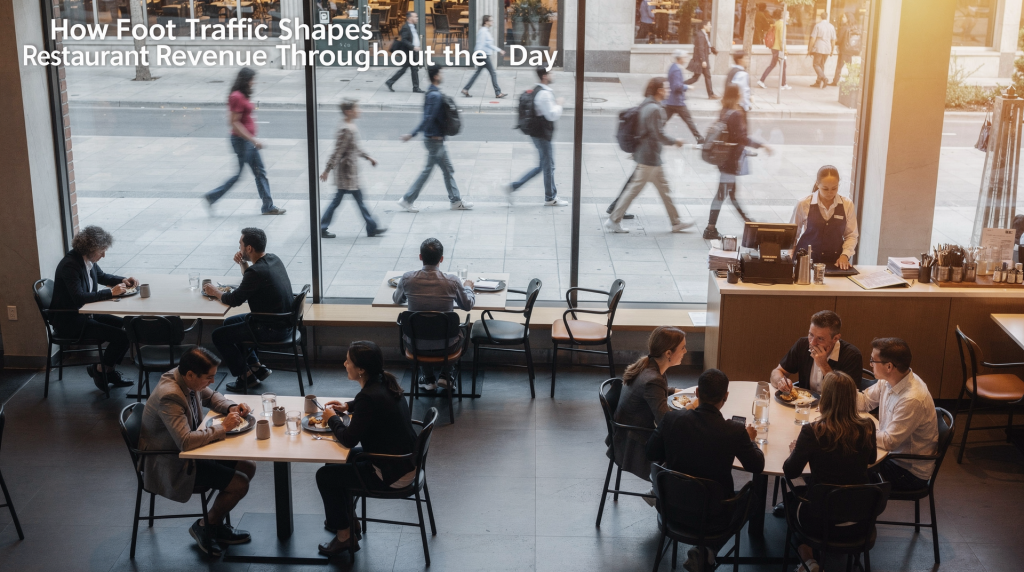
Foot traffic doesn’t hit a restaurant evenly. It swells during certain hours, vanishes during others, and only turns into revenue when the people on the sidewalk actually match what you’re selling, at the price you’re charging, during the hours you’re open. The most “busy” corner in town can be a money pit for the wrong concept, while a quieter side street prints cash if the traffic curve aligns with your dayparts. I learned this the hard way running a brewpub: our best location wasn’t the one with the highest headcount — it was the one where the right people walked by when our kitchen and taproom were ready for them.
Why Foot Traffic Matters So Much
Restaurant revenue boils down to three simple multipliers: how many people pass your door, how many of them actually notice you, and how many decide to walk in. That’s why foot traffic isn’t just a broker’s bullet point — it’s a real-time sales engine that changes shape from morning to night.
A lunch-driven deli can crush it on a block that turns into a ghost town after 3 p.m. Meanwhile, a dinner-only concept on that same block will bleed cash, no matter how impressive the midday counts look. The sidewalk itself is neutral; what makes it valuable is whether its rhythm matches your revenue windows. When I was scouting for our second taproom, a broker showed me a space with stellar 8 a.m. numbers near a transit hub. But our business lived and died after 5 p.m. — the morning crowd wasn’t going to come back for a flight of IPA and a burger. We passed.
The Core Idea: Match Traffic to Dayparts
The only foot traffic worth caring about is qualified traffic: pedestrians who are likely to want your food, comfortable with your average check, and walking by during the hours you actually make money. Raw pedestrian volume is a vanity metric if the crowd doesn’t convert.
Consider these real-world mismatches:
- A commuter corridor might pump out heavy breakfast and lunch flow but dry up completely by dinner — perfect for a coffee shop, disastrous for a sit-down bistro.
- A nightlife district surges after 6 p.m. but stays dead all morning. If you’re a bakery relying on 7 a.m. croissant sales, you’ll starve.
- A neighborhood retail strip might buzz on weekends but thin out on weekdays, leaving a weekday lunch spot struggling to cover CAM charges and payroll.
The goal isn’t to find the busiest block. It’s to find the block where the traffic pattern overlaps with your concept’s peak revenue hours. That means studying the traffic curve, not just the traffic total.
How Foot Traffic Shapes Revenue by Daypart
Breakfast
Morning concepts live or die on early pedestrian flow. You’re relying on commuters, hotel guests, and neighborhood regulars who want speed and consistency. If your menu depends on quick turnover and repeat visits, the site must generate enough visible morning movement to support a steady stream of drop-ins — not just a spike at 8:15 a.m. that vanishes by 9.
Best-fit locations often include transit corridors, office-heavy districts, hotel clusters, and neighborhood corners with early school or gym traffic. But watch out: a spot right at a subway entrance might give you volume, but if everyone is sprinting to catch a train, your average ticket stays low and no one lingers for a second cup. I’ve seen coffee shops in those spots do great unit numbers but struggle to build the kind of regular base that sustains a business through lease renewals and rent hikes.
Lunch
Lunch is frequently the strongest daypart for fast-casual, cafés, bakeries, and QSR-style operations because you’re capturing workers, students, and nearby residents in a compressed window. The challenge is conversion: lunch traffic moves fast, so visibility and frictionless entry matter as much as the raw count. If someone has to cross a busy street against the light or can’t spot your storefront from the main pedestrian flow, you’ll lose them to the place that’s easier to reach.
Strong lunch locations usually have dense office or institutional demand, clear storefront visibility, simple access from sidewalks and crosswalks, and nearby “reason to stop” businesses — banks, retail, services, medical offices. A brewpub with a solid lunch menu, for instance, might anchor itself near a hospital or university where staff and visitors need a quick but quality meal. But if the kitchen layout can’t handle a 90-minute rush, even perfect traffic won’t save you; you’ll just watch potential guests walk past while tickets pile up.
Dinner
Dinner revenue depends less on passing volume and more on evening dwell time, destination behavior, and willingness to make a trip. A restaurant can have modest pedestrian counts and still do excellent dinner business if the area generates the right kind of evening occasion traffic — couples, groups, families treating the meal as an event.
Good dinner sites often sit near residential neighborhoods, entertainment districts, hotels, destination retail, or dense mixed-use blocks. Parking and access become critical here. Our brewpub was in a walkable neighborhood, but we still needed a small lot for the suburban crowd that drove in after work. If zoning had restricted our hours or if CAM charges had eaten up the savings from a lower-traffic street, the economics wouldn’t have worked. Dinner concepts need to think about the entire arrival experience, not just the sidewalk count.
Late Night
Late-night trade is highly specific and usually depends on bars, event venues, transit, or 24-hour activity. If your concept relies on it, you need to measure traffic after normal dinner hours instead of assuming daytime counts will translate. A street that’s packed at 8 p.m. might empty out by 11 p.m. once the movie theater lets out.
I’ve watched late-night spots fail because they signed a lease based on Friday and Saturday bar crawls, only to discover that Sunday through Thursday the area was a dead zone. If you’re running a kitchen until 1 a.m., make sure the foot traffic exists on a Tuesday in February, not just a Saturday in June. Also check whether neighboring businesses have similar hours — if you’re the only place open late, you might attract unwanted attention rather than profitable guests.
What to Measure Beyond Headcount
Foot traffic becomes a real decision-making tool when you study it like an operator, not just a broker. The most important questions aren’t only “how many people?” but “who are they?”, “when do they pass?”, and “do they stop?”. A counter on the sidewalk won’t tell you that half the pedestrians are tourists who never eat off the main drag, or that the flow shifts to the shady side of the street in summer.
Here’s what I track when evaluating a space:
| Metric | Why it matters |
|---|---|
| Hourly pedestrian count | Shows when the street actually produces potential customers — not just a daily average that hides dead zones. |
| Day of week | Reveals whether the area works for weekday, weekend, or both. A brunch spot needs strong Saturday/Sunday flow; a business-district salad joint needs Monday–Friday. |
| Direction of travel | Helps you understand which side of the street gets the best flow. I’ve seen restaurants lose 30% of potential traffic simply because they were on the “wrong” side of a one-way pattern. |
| Stopping behavior | Shows whether people pause, browse a menu, or keep moving. This is a direct signal of interest and conversion potential. |
| Visibility | Determines whether walkers even notice your storefront. A recessed entrance or a window cluttered with signage can make you invisible even in heavy traffic. |
| Nearby demand generators | Offices, schools, homes, hotels, and retail shape traffic quality. A gym next door might feed a smoothie bar but do nothing for a steakhouse. |
A Practical Way to Evaluate Foot Traffic
A good site visit isn’t a drive-by glance. The strongest approach is to observe the location during the exact periods that matter for your business — and to do it more than once. When I was looking at spaces for the brewpub, I’d bring a notebook and stand outside like a weirdo for 30 minutes at a time, counting heads and watching behavior. That data saved me from at least two bad leases.
Step-by-step site check
- Pick your key dayparts: breakfast, lunch, dinner, and late night if relevant. Don’t assume — know which hours drive your revenue.
- Stand outside the site for 15- to 30-minute blocks. Short counts miss the rhythm.
- Count pedestrians and note whether they slow down or pass through quickly. A fast walker isn’t a customer.
- Watch traffic from both directions on the street. The near side vs. far side can differ dramatically.
- Look at visibility from the sidewalk, corner, and parking approach. Can you read the signage from 50 feet away?
- Repeat the visit on a weekday and a weekend day. Patterns shift.
- Re-check in different weather or during local events if those conditions affect demand. A patio-dependent restaurant needs to know what happens when it rains.
A simple field note template
Use this when visiting candidate sites — it forces you to record what actually matters, not just your gut feeling:
- Time block:
- Day:
- Weather:
- Pedestrian count:
- Peak direction of flow:
- People who paused:
- People who entered nearby businesses:
- Visibility from 50 feet:
- Parking or access issues:
- Best-fit daypart for this site:
How Traffic Timing Affects Revenue
The shape of traffic matters as much as the number. A location with strong midday flow and weak evenings may produce excellent lunch sales but underperform after 4 p.m. That same site could be ideal for a café, sandwich shop, or bakery, but a poor choice for a dinner-driven concept. Conversely, a street with a big evening surge can support a bar-forward or dinner-first restaurant, but may not justify a breakfast program if the morning count is too low to cover labor and buildout costs for a morning setup.
This is why experienced operators think in terms of traffic curves, not just traffic totals. I plot out hourly counts for a full week when I’m serious about a space. A flat curve with moderate volume can be more predictable and profitable than a spikey curve with huge peaks and deep valleys. Predictability matters when you’re scheduling staff, ordering inventory, and negotiating a lease with landlord expectations.
Common Mistakes Operators Make
Mistake 1: Chasing the busiest block
A crowded street is not automatically profitable. If the crowd is wrong for your concept or appears at the wrong time, revenue will still lag. I’ve seen a coffee shop open on the busiest retail strip in town, pay top-tier rent, and then struggle because the foot traffic was mostly tourists looking for souvenirs, not a $4 latte. The rent ate them alive.
Mistake 2: Ignoring direction and visibility
A site can sit on a busy street and still miss sales if pedestrians walk on the opposite side, signage is weak, or the storefront is hard to see. Our first brewpub had a recessed entry that was invisible from the main crosswalk. We fixed it with better lighting and an awning, but those tenant improvements cost money we hadn’t budgeted. Check sightlines before you sign.
Mistake 3: Measuring once and assuming the pattern holds
Traffic shifts by weekday, season, weather, school schedules, and events. One observation is not enough. I learned this when a summer visit to a potential space showed great flow, but a return in January revealed a 60% drop. If your lease term is five years, you need to know the full annual cycle.
Mistake 4: Treating all concepts the same
A coffee shop, bakery, lunch counter, and dinner restaurant need very different traffic profiles. The same corner that prints money for a breakfast taco stand might starve a fine-dining concept. Match the traffic curve to your specific operating hours and service style.
Mistake 5: Confusing foot traffic with conversion
Traffic only becomes revenue when people notice the business, decide it is for them, and can enter easily. A high-traffic location with a confusing entrance or a menu that doesn’t match the crowd will underperform a quieter spot that nails the guest experience from the sidewalk. I always watch how many people glance at the door versus how many walk in — that ratio tells you more than any broker packet.
How to Use Foot Traffic in Revenue Forecasting
Foot traffic becomes a forecasting tool when you combine it with realistic conversion assumptions and average check size. A high-flow location with poor conversion can underperform a quieter location that is easier to enter and better matched to your audience. I build simple models that multiply hourly pedestrian counts by an estimated capture rate (which varies by daypart) and average check, then extend across operating hours and open days per week.
Even small differences in capture rate can materially change sales. For example, a lunch spot might capture 3% of passersby on a Tuesday but only 1.5% on a Friday when office workers leave early. If you use a flat 3% assumption, you’ll over-forecast. That’s why site selection should compare traffic quality, not just traffic quantity. A space with lower volume but a higher capture rate because of better visibility and easier access can easily outperform a “busier” location.
Checklist: Is This Foot Traffic Right for Your Restaurant?
Use this quick filter before signing a lease. If several answers are no, the site may look active but still fail to produce revenue.
- The strongest traffic happens during my highest-value daypart.
- The people passing by match my target customer — in age, spending habits, and dining occasion.
- The storefront is visible from the main pedestrian approach, not hidden by columns, trees, or grade changes.
- Guests can stop, enter, and leave easily — no confusing stairs, heavy doors, or dangerous crossings.
- The area has natural demand drivers that support my concept (offices for lunch, residences for dinner, etc.).
- Traffic is strong on the days I need, not just one isolated time (e.g., Saturday brunch vs. Wednesday lunch).
- The site still works if weather or seasonality reduce volume — a patio-dependent concept must have indoor backup.
- Parking or transit access doesn’t create a barrier for my core customers.
Foot Traffic by Concept Type
| Concept type | Best traffic pattern | Risk if traffic is wrong |
|---|---|---|
| Coffee shop | Early morning commuter flow, with a secondary mid-morning bump from locals and freelancers | Weak breakfast sales; can’t cover labor and rent before noon |
| Bakery | Morning and midday browsing traffic — people with time to stop, not just rush past | Low impulse purchases; day-old inventory kills margins |
| Fast-casual lunch spot | Midday office and retail traffic, dense within a 5-minute walk radius | Slow lunch volume; can’t hit the turnover needed to survive on thin margins |
| Casual dinner restaurant | Evening resident and destination traffic, with easy parking or walkability from nearby homes | Empty dining room after 5 p.m.; fixed costs eat you alive |
| Late-night concept | Post-event and nightlife traffic, consistent across weekends and weekdays | No meaningful late sales; security concerns if area empties out |
Final Takeaway
Foot traffic shapes restaurant revenue by determining not just how many guests can see you, but when they see you and whether the moment matches your menu, price point, and service style. The best restaurant location is not the one with the most bodies on the sidewalk — it’s the one with the right bodies at the right time. I’ve walked away from “hot” corners because the traffic curve didn’t fit our brewpub’s evening-heavy model, and I’ve signed leases on quieter streets where the dinner crowd arrived like clockwork. In the end, a lease is a long-term bet on a traffic pattern. Make sure you’ve studied it like an owner, not just a tenant.
FAQ
Does high foot traffic always mean higher sales?
No. High traffic only helps if it matches your target customer and your peak dayparts. I’ve seen 20,000 daily passersby produce less revenue than 2,000 if the crowd doesn’t convert. It’s about alignment, not volume.
How long should I observe a potential restaurant location?
At minimum, check multiple dayparts on different days, including one weekday and one weekend period. I typically do three to four visits per candidate site, covering the hours I plan to operate, and I always include a “bad weather” day if the concept has outdoor seating.
What matters more: foot traffic or visibility?
They work together. Traffic creates opportunity, but visibility determines whether pedestrians notice and act. A storefront that’s invisible from 50 feet away might as well be on a dead-end street. Invest in signage, lighting, and an unobstructed entrance — and negotiate for tenant improvements to cover those costs if the space needs work.
Can a restaurant succeed in a low-foot-traffic area?
Yes, if it is a destination concept with strong drive-to demand, good parking, and a compelling reason to visit. Our brewpub drew from a 20-minute radius because people came specifically for the beer and atmosphere. But you need to be honest about whether your concept has that pull, or if you’re relying on walk-by discovery.
What is the biggest mistake in site selection?
Assuming that busy equals profitable. The real question is whether the traffic curve supports your specific concept and operating hours. I’ve watched operators sign leases based on a broker’s “high foot traffic” claim, only to realize the crowd was all wrong for their daypart or price point. Always verify the data yourself, on your own time, with your own eyes.