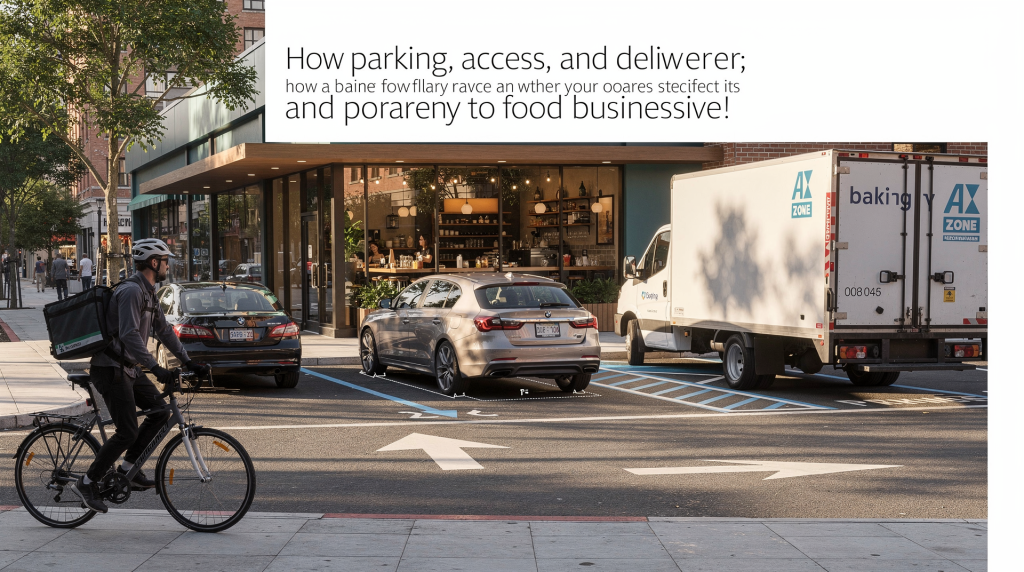
Parking and access aren’t minor conveniences for food businesses — they directly shape sales velocity, labor efficiency, guest satisfaction, and delivery performance. I’ve seen well-concepted restaurants with strong menus and beautiful branding underperform simply because guests struggled to get in the door, drivers couldn’t stop safely, or suppliers kept disrupting service during peak hours. The space itself was fine. The approach to it was broken.
When you’re signing a lease, it’s easy to obsess over rent per square foot, visibility from the main road, or whether the demographic data looks right. But access is the mechanism that converts all that theoretical demand into actual visits and orders. Miss that piece, and you’re leaving money on the curb — sometimes literally.
Why access decisions matter more than most operators expect
Location analysis typically obsesses over rent, visibility, and nearby demand density. That’s understandable — those numbers are easy to pull from a broker’s package or a demographic report. But access determines whether that demand actually converts into visits and orders. I’ve watched customers circle the block twice, fail to figure out where to park, and drive off to a competitor before they ever saw our taproom. That’s revenue walking away before the guest even opens the door.
If delivery drivers can’t find a legal place to stop, orders arrive late, get marked down in delivery apps, or pile pressure onto kitchen staff who end up managing frustrated couriers instead of cooking. Those negative ratings compound. Third-party platforms algorithmically punish consistently late pickups, which means your listing gets buried over time — all because the physical pickup workflow was an afterthought during site selection.
Access problems also show up in hidden costs that don’t appear on a P&L as a line item but absolutely erode margin:
- longer customer dwell time before the visit even starts, which kills throughput during busy windows
- slower table turns during peak periods because guests arrive flustered and take longer to settle
- more staff time burned answering parking questions by phone or directing confused guests outside
- courier bottlenecks during rushes that cascade into cold food and refund requests
- supplier delays at receiving time that push prep schedules off track
- higher frustration for guests with mobility limitations, which is both a service failure and a legal exposure
For many concepts, especially restaurants with takeout, delivery, or high daytime volume, access isn’t a supporting detail — it’s part of the product itself. Your guests experience the arrival before they taste the food.
The three access factors that influence performance
1. Parking
Parking is about far more than the number of spaces listed on the property sheet. The real question is whether guests can park quickly, legally, and without stress — and whether the parking experience primes them for a good visit or a tense one.
A site with 20 spaces can still perform poorly if those spaces are hard to see from the street, the lot is shared with neighboring businesses that have overlapping peak hours, the entrance angle is awkward to navigate, the markings are faded or confusing, or turnover is slow because cars keep circling looking for an elusive open spot. I’ve seen lots where four spaces were effectively unusable because the layout forced a three-point turn that nobody wanted to attempt during lunch traffic.
A smaller lot can absolutely work if the concept is walkable, delivery-friendly, or close to a destination people already plan to visit — like a park, a transit hub, or a cluster of complementary retail. The math isn’t just about space count; it’s about whether the parking capacity matches your peak-hour demand curve.
2. Physical access
Physical access includes how people enter and leave the property — and this is where site visits at the wrong time of day can give you dangerously misleading data.
You need to look at ease of turning into the lot, whether left-turn entry across traffic is realistic during rush hour, visibility from the street at actual driving speed (not walking speed), sidewalk quality and crosswalk placement, lighting and perceived safety at night, entrance placement for first-time visitors who won’t know the layout, and whether guests must cross paths with delivery or waste traffic.
A difficult turn-in across a busy arterial road can be enough to kill lunch traffic on its own. Guests are far less tolerant of friction when they’re on a work break or picking up food quickly. They’ll choose the place with the easy right-turn entry every time, even if your food is better. I’ve learned this the hard way — we lost a measurable chunk of our weekday lunch business to a competitor with a drive-thru and a simpler lot, and it took me too long to connect their convenience advantage to our softening numbers.
3. Delivery routes
Delivery routes affect both guest experience and kitchen operations, and they’ve become dramatically more important as third-party delivery has shifted from a nice-to-have to a core revenue channel for many concepts.
You need to know where drivers will stop, whether they can wait without blocking guest parking or the main entrance, how they enter the building or reach the pickup area, whether there’s a back door, loading dock, or designated handoff point, and whether delivery trucks can access the site without blocking service flow. If the only way to receive goods is through the front door, deliveries will interrupt dining room flow and create avoidable chaos — I’ve seen linen deliveries roll through a packed brunch service, and the guest experience damage was immediate and lasting.
What different food business models need
| Concept type | What matters most | Common risk |
|---|---|---|
| Full-service restaurant | Guest parking, easy entry, comfortable arrival experience, delivery access separated from dining flow | Guests avoid the site if parking feels difficult or first-time visitors can’t figure out where to go |
| Fast-casual | Fast in-and-out flow, short-stay parking near the entrance, curbside pickup, clear signage for pickup vs dine-in | Congestion during lunch and dinner peaks when dine-in and takeout customers compete for the same spaces |
| Café | Walkability, quick stops, bike or street parking, simple pickup workflow | Customers skip visits entirely if parking is confusing or the stop requires more than a few minutes |
| Bakery | Early-morning access, easy grab-and-go parking, smooth receiving for wholesale deliveries | Supplier and pickup traffic overlap during the morning rush, creating chaos at the entrance |
| Delivery-led concept | Courier access, curb space allocation, efficient handoff, route efficiency for multiple platforms | Poor delivery ratings from pickup delays that compound into lower app visibility over time |
| Destination restaurant | Strong visibility, memorable arrival experience, parking within a reasonable walk, safe nighttime access | “Special occasion” guests still expect easy access — a frustrating arrival poisons the mood before the meal starts |
How parking affects sales and guest behavior
Parking influences whether a guest completes the visit before they even get out of the car. That sounds dramatic, but I’ve watched it happen enough times to know it’s a real, measurable phenomenon.
Guests judge a site on how long it takes to find a space, whether the lot feels safe and well-lit, whether parking is free, paid, or validated, whether they can tell where to go once they park, and whether they need to walk through a confusing shared property or cross a poorly marked lot. These judgments happen in seconds from behind the wheel, and they’re surprisingly hard to reverse with good service once the guest is inside.
If parking is poor, some guests substitute takeout or delivery — they still want your food but won’t endure the arrival friction. Others choose a competitor with easier access, often without even consciously weighing the decision; they just default to the smoother experience. For a neighborhood café, that may mean losing repeat traffic that you depend on for weekday baseline revenue. For a dinner-driven restaurant, it may mean losing groups who would have spent significantly more per head.
Parking that works well
- clearly marked spaces with well-maintained striping
- a simple one-way traffic pattern that eliminates guesswork
- short walking distance to the entrance — ideally under 100 feet for quick-service concepts
- visible signage from the street that confirms you’re in the right place
- lighting that makes the lot feel safe at night
- enough room for larger vehicles where relevant, especially in markets where SUVs and trucks dominate
Parking that creates friction
- shared lots with unclear rules about who can park where and when
- tight turns that make larger vehicles struggle
- hidden entrances that first-time guests miss entirely
- valet dependency without a clear process — guests get confused about whether they must use it or can self-park
- parallel street parking that becomes impossible at peak hours when adjacent businesses are busiest
- lots used by neighboring businesses at the same time, creating competition and congestion
How access shapes the customer experience
Access is the bridge between demand and actual revenue. A site may sit in a strong trade area with great demographic density, but if the physical approach is frustrating, the business captures far less of that demand than the market analysis would predict. I’ve seen two restaurants with nearly identical concepts in the same corridor perform dramatically differently, and the main variable was the arrival experience.
A good access experience feels intuitive and invisible — the guest barely notices it because nothing gets in their way. The sequence usually looks like this: the customer spots the location quickly from the road, they can enter without making a difficult turn or crossing multiple lanes of traffic, they find parking or a safe drop-off spot within a comfortable distance, they know which door to use because signage makes it obvious, and they enter without crossing operations traffic like delivery trucks or waste bins.
A bad experience follows a different arc entirely: the customer misses the entrance and has to circle back, they circle the block and start getting frustrated, they can’t tell where to park or whether they’re even allowed to use a particular lot, and by the time they walk in they’re already annoyed — or they give up and leave altogether.
That emotional shift matters more than most operators realize. Guests who arrive stressed often spend less time browsing, are less patient with wait times, and are far less likely to return. The arrival experience sets the emotional baseline for everything that follows, and recovering from a bad first impression is expensive in terms of both comps and lost repeat visits.
How delivery routes affect food businesses
Delivery now affects more than third-party order volume — it changes how the entire building should function. What used to be a secondary consideration when delivery was maybe 5% of revenue has become a core operational design constraint now that it’s 15-30% or more for many concepts.
A site with poor delivery circulation can create cascading problems: late pickups that tank order accuracy and temperature, confused drivers wandering through the dining room asking for orders, blocked entrances during peak hours, kitchen congestion as drivers crowd the expo area, lower app ratings that reduce your visibility in third-party platforms, and growing tension between FOH staff and delivery logistics.
For high-volume delivery businesses, route efficiency matters just as much as the interior layout. Drivers need a path that is predictable, safe, and fast — they’re paid per delivery, so every minute spent navigating a confusing site is a minute they’re losing money, and they’ll remember that when deciding which orders to accept.
Questions to ask about delivery access
- Can a driver stop without blocking guest traffic or the main entrance?
- Is there a place to wait if orders aren’t ready — without that wait spilling into the dining room?
- Can a courier find the entrance without walking through the entire restaurant and disrupting service?
- Is there a separate handoff point for takeout and delivery that keeps both flows distinct?
- Can vendors reach receiving without interrupting service, especially during peak hours?
- Will trash pickup, food deliveries, and customer arrivals conflict in the same zone at the same time?
When delivery access is especially important
- lunch-heavy concepts where thirty-minute windows are make-or-break
- ghost kitchen models where the entire business depends on driver throughput
- suburban takeout-focused restaurants where dine-in is secondary
- bakeries with daily wholesale receiving that must happen before the retail rush
- cafés with strong app-based pickup volume during the morning commute window
- restaurants with beverage, produce, or commissary deliveries several times a week that can’t afford scheduling conflicts
The hidden impact on labor and operations
Bad access doesn’t just inconvenience guests. It burns labor — and in a business where labor is often 30-35% of revenue and climbing, that’s a cost you can’t afford to ignore.
Staff time gets lost in small, repeated tasks that add up across a shift: answering parking questions by phone when hosts should be seating guests, directing drivers outside when they can’t find the pickup entrance, moving between front door and back door to manage disjointed workflows, handling delayed vendor arrivals that push prep off schedule, resolving customer confusion about where to go for pickup versus dine-in, and managing curbside handoffs without a clear system or designated zone.
That time adds up. In a tight-margin business, even a few minutes per transaction can become a measurable drag on productivity. If a host spends five minutes per shift directing lost drivers, that’s half an hour a week of labor that contributes nothing to guest experience or revenue — multiply that across a team, and the numbers get uncomfortable fast.
Access also affects stress levels in ways that don’t show up on spreadsheets but absolutely show up in turnover and morale. Teams work better when the site has a clean flow for guests, vendors, and drivers. When everything collides at the same choke point — the front door, the host stand, the pickup counter — service becomes harder to sustain, and good employees start looking for places where the operational friction is lower.
How to evaluate a site before signing a lease
Use a real-world site visit, not just a listing description or a broker’s assurances. I’ve learned through painful experience that a property can look perfect on paper and fall apart under real operating conditions. The time to discover that is before you sign a lease, not after you’ve committed to a ten-year term.
Step-by-step site check
- Visit at different times of day, especially lunch, dinner, and weekend peak hours — don’t trust a Tuesday at 10 a.m. to predict a Saturday at 7 p.m.
- Count visible parking spaces and note whether they are clearly assigned or shared with neighboring tenants.
- Watch how cars enter, exit, and turn around — follow the actual traffic flow multiple times.
- Walk the guest path from parking area to front door at the pace a customer would, not a site inspector.
- Observe where a delivery driver would stop and whether that spot would still work during a dinner rush.
- Check whether trucks or suppliers can access the back of the building without blocking guest areas.
- Look for conflicts with trash, grease pickup, patio seating, or neighboring tenants’ operations.
- Ask about parking rules, restrictions, and any shared-use agreements — get specifics, not reassurances.
- Confirm lighting, signage, and pedestrian safety after dark.
- Test the site as if you were a first-time guest who has never been there before and doesn’t know the shortcuts.
Site-visit checklist
- Can a guest find the entrance in one pass without slowing down or guessing?
- Is there enough short-stay parking for your expected peak demand?
- Are there clear signs for pickup or delivery that a courier can see from the driver’s seat?
- Can vendors unload without blocking the front door during operating hours?
- Is there safe access after dark, including adequate lighting and clear sightlines?
- Do curb conditions support quick stops for takeout and delivery pickups?
- Are there mobility-friendly routes from parking to entry that don’t require navigating stairs or uneven terrain?
- Does the layout support separate dine-in and pickup traffic, or do both flows collide at the same narrow point?
Common mistakes operators make
Mistake 1: Judging parking only by the total number of spaces
A parking count on a spec sheet doesn’t show usability. I’ve seen lots with 40 spaces that effectively delivered only 20 functional spots because the layout was awkward, eight spaces were hidden behind a dumpster enclosure, and the rest were shared with a busy neighboring tenant. Layout, timing, and competition for spaces during peak hours matter just as much as the raw count.
Mistake 2: Ignoring delivery flow until opening
Many operators design the guest experience first and figure out driver access later, treating it as a detail to solve during buildout. That often leads to bottlenecks that are expensive to fix — moving walls, reconfiguring entrances, or retrofitting a separate pickup counter after construction is complete costs multiples of what it would have cost to plan it correctly from the start.
Mistake 3: Assuming customers will adapt
Some guests will tolerate inconvenience, especially if your concept is unique or beloved. But not enough guests will tolerate it to protect weak operations. If access is consistently frustrating, the market usually finds a better option — and modern consumers have more options than ever. Loyalty gets tested every time someone has to circle the block.
Mistake 4: Forgetting the back of house
Receiving, waste pickup, and supplier access should be planned with the same care as the dining room entrance. I’ve seen line cooks have to stop working during rush to help navigate a produce delivery through the front door because there was no rear access. That’s an operational failure, not a one-time inconvenience. Back-of-house access is infrastructure, not an afterthought.
Mistake 5: Not checking peak-hour conditions
A lot that feels spacious and manageable at 10 a.m. may completely collapse at 12:15 p.m. or 6:30 p.m. The site must work when it is busiest, not when it is empty. I’ve watched operators sign leases based on off-peak site visits and then spend years dealing with access problems they could have identified in a single well-timed observation.
Practical rules of thumb by concept
| If your concept is… | Prioritize… |
|---|---|
| Neighborhood café | Fast curb access for morning commuters, easy parking for quick stops, strong walkability for local foot traffic |
| Bakery | Early access for wholesale customers, quick-stop parking, smooth receiving flow that doesn’t conflict with retail hours |
| Casual restaurant | Clear lot flow that first-time visitors can navigate, visible entrance from the street, enough short-stay parking for peak dinner demand |
| Fast-casual or pickup-heavy | Curbside and courier access zones, separate order pickup flow that doesn’t mix with dine-in traffic |
| Delivery-driven brand | Driver circulation patterns, loading ease, fast handoff process that minimizes wait time for couriers |
| Upscale dining | Valet or premium parking options, intuitive arrival experience, safe nighttime access with good lighting and clear paths |
A simple framework for deciding if a site works
After years of evaluating sites and watching concepts succeed or struggle, I’ve boiled the access decision down to three questions. If a site can’t answer all three convincingly, I walk away — or I make sure the lease terms give me enough flexibility to fix the problems before they become permanent.
1. Can guests get here easily?
If the answer is no — or even “maybe, depending on traffic” — the site may need a different concept, stronger signage investment, or a parking solution that you can actually implement. Don’t assume you can overcome access problems with better marketing. You can’t market your way out of a bad arrival experience.
2. Can drivers and vendors use the space without disrupting service?
If the answer is no, expect operational friction from day one. That friction will show up in delivery ratings, staff turnover, supplier relationships, and guest complaints. It may not sink the business, but it will make every day harder than it needs to be.
3. Does the access pattern fit the business model?
A delivery-first concept can survive with less traditional parking than a dine-in concept — couriers don’t need parking spots, they need curb access. A full-service restaurant usually cannot survive without adequate guest parking unless it’s in a dense urban core with robust alternatives. Match the access profile to the concept, not the other way around.
Final takeaway
Parking, access, and delivery routes are not side issues to optimize after the lease is signed. They shape how guests feel from the moment they arrive, how staff work through every shift, how suppliers move through the property, and how much revenue a food business can realistically capture from the demand that exists around it. The best location is not just visible or affordable — it is physically easy to use for everyone who needs to get in, out, and through the site: guests, drivers, vendors, and staff alike.
If a space forces too much friction at the curb, in the lot, or at the back door, that friction eventually shows up in sales — slower turns, lower check averages from frustrated guests, fewer repeat visits, and declining delivery performance. The time to solve access problems is before you commit to the space, not after you’ve built a business around a bottleneck.
FAQ
How much does parking matter for restaurants?
Parking matters whenever guests arrive by car, which in most markets means parking matters a lot. Even a strong concept with excellent food and service can lose business if parking is confusing, limited, or far from the entrance. The question isn’t whether parking matters — it’s whether your specific parking situation matches your specific guest expectations and peak demand patterns.
Is delivery access important for dine-in restaurants?
Yes, and this is one of the most commonly overlooked factors in site selection. Even purely dine-in concepts receive food, beverage, linen, trash, and maintenance deliveries. Poor delivery access can disrupt the guest experience during service hours, create safety issues, and add unnecessary labor costs as staff scramble to manage vendor arrivals.
What should I check first during a site visit?
Start with the guest arrival path from the moment someone sees your sign from the road: street visibility at driving speed, turn-in ease during actual traffic conditions, parking availability and clarity, and whether the entrance is obvious to someone who has never visited before. If that chain breaks anywhere, the rest of the site evaluation needs to account for that friction.
Can a restaurant succeed without on-site parking?
Yes, if the concept is highly walkable, transit-friendly, delivery-oriented, or located in a dense area where guests expect to park nearby and walk. Urban brewpubs, neighborhood coffee shops in pedestrian zones, and delivery-led ghost kitchens all operate successfully without dedicated parking. The key is that the business model and location are aligned — you can’t drop a parking-dependent suburban concept into a no-parking site and expect it to work.
What is the biggest mistake in evaluating access?
Treating it as a minor detail to optimize later instead of a core part of operations that shapes revenue from day one. Access problems are often expensive to fix after the lease is signed — reconfiguring entrances, negotiating shared parking agreements, or retrofitting separate delivery access are all far more costly and complex than evaluating the site correctly before committing.