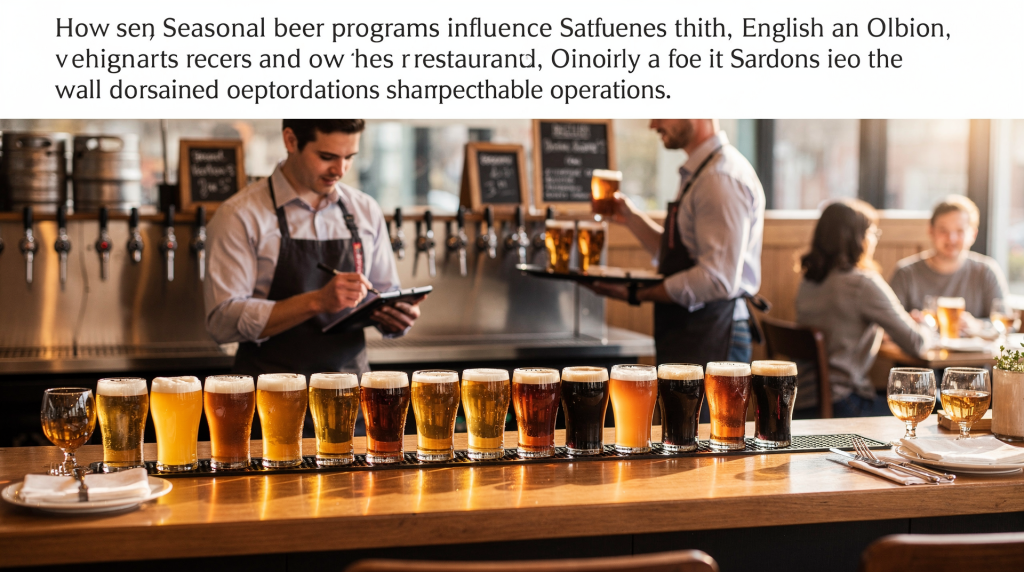
Seasonal beer programs are not just a way to keep the tap list interesting. They reach into every corner of the operation — ordering cycles, kitchen flow, labor scheduling, menu design, staff training, guest expectations, and cash flow. When managed with discipline, they can smooth out the natural peaks and valleys of restaurant revenue. When treated as an afterthought, they create friction that shows up in waste, confused staff, and missed sales.
For any restaurant that treats beer as a serious revenue driver — not just a checkbox on the beverage list — the seasonal calendar needs to be built into the operating rhythm from the start. That means the kitchen, the bar, and the front of house all move to the same beat.
Why seasonal beer matters operationally
A seasonal beer program rewires how a restaurant buys, stores, sells, and staffs around beverage inventory. Rotating offerings keep the menu feeling current without forcing you to abandon the dependable core beers that regulars count on. Done right, seasonals create a reason for repeat visits and give the floor team a story that actually sells — not just a list of tasting notes to recite.
The operational upside is tangible:
- Guests perceive the program as intentional and current, not a random collection of handles.
- Limited-time offerings can lift check averages when paired with food — a $9 seasonal saison next to a $16 roast chicken special is an easier upsell than a standalone pint.
- Rotations help move inventory in sync with weather and demand patterns. You are not sitting on cases of imperial stout in July.
- Seasonal pairing opportunities make staff recommendations feel natural, not forced.
- A planned cycle reduces the risk of stale, slow-moving beer that quietly eats margin through discounting or, worse, drain pours.
The downside is just as real, and I have lived every one of these:
- Forecasting becomes more complex. You are guessing demand for a beer that did not exist on your menu last month.
- Training needs spike because staff must learn new styles, new stories, and new pairings more often — and in this industry, turnover means you are always training someone.
- Inventory errors show up faster when shelf life is short. A case of IPA that sits three weeks past its prime is a liability, not an asset.
- Menu changes create cascading operational headaches: printing costs, POS updates, website syncs, table tents, and the inevitable moment when a guest orders the beer that was on the old menu.
- A poorly timed launch — too early, too late, too much, too little — can leave a restaurant overstocked with product nobody wants yet or understocked when demand hits.
How seasonal beer programs affect day-to-day restaurant operations
1. Inventory planning gets more precise
Seasonal beer is almost always more time-sensitive than a core lineup. Buying decisions need to be tied to realistic demand forecasts, not the enthusiasm of the buyer who fell in love with a sample at a distributor tasting. The operators who do this well typically structure their program in layers: a dependable core that never moves, a rotating seasonal tier that changes with the calendar, and a small experimental slot for one-offs and limited releases. This balance preserves consistency while leaving room for novelty.
A practical approach that has saved me more than once:
- Keep your top sellers stable. Do not touch the IPA that pays the rent.
- Reserve a smaller number of taps or menu slots for seasonals — do not let them take over the board.
- Order conservative first fills until velocity is proven. You can always reorder; you cannot un-order.
- Review sales weekly, not monthly. A seasonal that is not moving by week two probably will not move by week four.
- Build a clear exit plan for slow movers before you order. Know whether it goes on happy hour, into a flight, or into a kitchen recipe.
Common inventory mistake
Ordering a seasonal beer as if it will sell like a flagship. It usually will not. Guests are curious, but curiosity has a short half-life. I have watched a beautifully crafted autumn ale gather dust because the buyer ordered it at the same volume as the year-round lager. The math does not work that way.
2. Storage and freshness become more important
Seasonal beers often have a shorter useful window in practice, even when they are technically still within code. Flavor shifts matter more in styles with delicate hop character, spice, fruit, or dessert notes. And here is where the physical space — the actual square footage you are leasing — becomes an operational factor. If your storage is warm, crowded, or poorly organized, seasonal products degrade faster and create waste that hits your P&L directly.
I have seen restaurants sign a lease on a beautiful dining room only to discover the back-of-house storage is a humid closet with no temperature zoning. When you are rotating seasonals, that kind of oversight turns into shrink. When negotiating a lease or planning a buildout, ask yourself: where is the cold storage going to live, and can it handle the seasonal swing in inventory volume?
Checklist for better storage:
- Store by release date, not just by SKU. The newest case should never be in front.
- Use first-in, first-out discipline religiously.
- Separate high-turn and low-turn items physically — do not bury a slow-moving seasonal behind the workhorse kegs.
- Track what is already on draft versus what is in reserve. The walk-in can hide mistakes until they become expensive.
- Review pour loss and dead stock weekly. If a seasonal is not pouring, it is occupying space and capital.
3. Labor and training needs rise
Seasonal beer rotates faster than a standard beverage lineup, which means staff need repeatable, scalable training. Front-of-house teams must know what changed, why it matters, and how to describe it without sounding like they are reading from a script. This is not a one-and-done training session; it is a recurring operational cost that needs to be factored into labor budgets.
One beverage program example I have seen work well ties beer education directly to pre-shift meetings and pairs it with food tasting. When the lineup changes, the team tastes the new beer alongside the dish it is meant to complement. That 10-minute investment pays off on the floor when a server can make a genuine recommendation instead of guessing.
A simple training framework that works even with high turnover:
- Explain the beer in one sentence — what it is, not what the brewer’s website says.
- Give the flavor profile in plain language. “Crisp, a little bready, with a lemon zip” beats “Belgian-style witbier with coriander and Curacao orange peel.”
- Share one ideal food pairing from your actual menu.
- Mention one guest type who will like it. “If you like Blue Moon, try this.”
- Practice a 15-second upsell line that does not sound like an upsell.
What staff should know for every seasonal beer
- Style
- ABV
- Flavor profile
- Sweetness or bitterness level
- Ideal serving temperature
- Recommended food pairing
- Whether it is limited or returning
If your team cannot answer these seven points without looking at a cheat sheet, the seasonal beer is not ready for the menu. Launch it after the training, not before.
4. Menu engineering becomes more dynamic
Seasonal beer should not live in isolation on a separate card. It works hardest when it supports food sales — and that requires coordination between the bar manager and the kitchen. Summer lagers, amber ales, pumpkin beers, winter stouts, and hop-forward spring releases can all push different menu items if they are positioned correctly on the page and in the server’s recommendation flow.
Here is how seasonal beer can support menu sales, drawn from real operational patterns:
| Beer style | Best operational use | Food pairing angle |
|---|---|---|
| Light lager | High-volume summer service | Salads, fried items, grilled seafood |
| Wheat beer | Warm-weather refreshment | Chicken, citrus dishes, goat cheese |
| Amber ale | Transitional fall menu | Burgers, roasted vegetables, barbecue |
| IPA | Core rotation or limited release | Spicy food, burgers, sharp cheeses |
| Stout | Cold-weather comfort | Desserts, braised meats, chocolate |
| Fruit beer | Seasonal feature or brunch | Salads, brunch plates, lighter fare |
The goal is not a pretty pairing note on the menu. It is to make ordering easier for guests and more profitable for the restaurant. When a server can say, “That Oktoberfest lager is incredible with our smoked pork chop,” the check average moves. When the pairing is just words on a page, it does not.
5. Pricing strategy needs seasonal discipline
Seasonal beers can support stronger margins when they are positioned as limited or premium. But the price should still reflect turnover risk, pour size, and demand reality. A seasonal beer that sells slowly can quietly become expensive if you are forced to discount it late in its life. And in a lease situation where CAM charges and occupancy costs are fixed, every pour that does not carry its weight erodes the margin you need to cover the space.
Use this pricing logic, refined from watching too many seasonals limp to the finish line:
- Higher rarity can justify premium pricing — but only if the guest perceives the value.
- Strong pairings can justify bundled offers. A beer-and-appetizer combo moves product faster than a standalone pint.
- Flights can move trial without forcing a full-pint commitment. They also let you charge a higher effective price per ounce.
- Happy hour can help introduce a new seasonal without deep discounting. A small price reduction for a limited window preserves perceived value.
- A beer of the month can create a predictable sales rhythm that helps with ordering and cash flow forecasting.
Building a seasonal beer program that works
Step 1: Start with your core identity
Before choosing rotating beers, define what should never change. A strong program usually keeps a few anchor beers available at all times so guests have something familiar to order — the beer equivalent of the menu item that never leaves the page. This is especially important in a neighborhood location where regulars are the backbone of revenue. If you are in a retail strip with heavy foot traffic from the same office workers every week, consistency builds trust.
Ask yourself:
- What styles are your regular guests loyal to? Do not guess — look at sales data.
- Which beers drive the best margins? Sometimes the crowd-pleaser is also the profit driver.
- Which beers pair with most of your menu? These are your workhorses.
- Which items are too niche to rotate out? If a beer brings in a specific guest segment, think twice before cutting it.
Step 2: Match rotation to the calendar
Seasonal beer works best when it actually feels seasonal. That sounds obvious, but many restaurants miss it by changing too late or too early. I have seen pumpkin beer launch in August and summer shandies still pouring in October. Guests notice, and it undermines the credibility of the program.
A simple rhythm that aligns with how people actually drink:
- Spring: lighter, brighter, citrus-forward — think saisons, pilsners, and session IPAs.
- Summer: crisp, refreshing, sessionable — lagers, wheat beers, and low-ABV options for long afternoons.
- Fall: amber, spice, malt, roast — Oktoberfest styles, brown ales, and the first stouts.
- Winter: rich, dark, warming — imperial stouts, barleywines, and spiced ales.
The point is not to chase trends blindly. It is to align beer with what guests already expect to want when they walk through the door. That alignment reduces the friction of selling something new.
Step 3: Coordinate launch timing with operations
A new beer release should not appear on the menu before the team is ready. This is where the operational discipline meets the marketing calendar. If any piece lags — POS updates, printed menus, table tents, tap handle labels, staff tasting, social media copy, kitchen pairings — guests feel the mismatch immediately. They order a beer that is not in the system, or they ask about a beer the server has not tasted.
Before any seasonal launch, confirm:
- POS is updated and tested.
- Printed menus are in hand, not at the printer.
- Table tents and signage are on the floor.
- Tap handles are labeled correctly.
- Staff have tasted the beer and know the pairing.
- Social media and website copy are live.
- The kitchen knows which dish to push alongside it.
If any of those lag, delay the launch. A clean launch a week late is better than a sloppy one on time.
Step 4: Set a review cadence
Seasonal beer should be managed like inventory, not art. Review it on a schedule, and be ruthless about cutting what does not perform. Sentimentality about a beer you personally love does not pay the lease.
Weekly questions that keep the program honest:
- What is moving fastest? Double down on that style next rotation.
- What is slowing down? If velocity drops, have a plan.
- Which seasonal is getting the most guest feedback? Positive or negative, it is data.
- Are any pours underperforming by daypart? A beer that sells at dinner but not lunch might need a different placement.
- Do staff recommendations match the sales data? If servers are pushing a beer that is not selling, the recommendation is not landing.
The operational benefits of a balanced tap mix
A healthy beer program mixes stability with novelty. The most practical model I have used reserves most tap space for dependable sellers while leaving a meaningful portion for seasonals and limited releases. That balance helps restaurants avoid two common problems: a stale menu that gives regulars no reason to return, and chaotic rotation that confuses everyone.
A balanced mix does three things well:
- Protects guest trust with familiar options — the beer they came for is still there.
- Keeps the program interesting for repeat visits — there is always something new to try.
- Reduces the risk of overcommitting to untested items that could become expensive drain pours.
Example of a workable rotation strategy
- 50–60% core beers that sell year-round — your anchors.
- 25–35% seasonals that change with the calendar — the reason to come back.
- 10–20% experimental or limited-time items — the conversation starters.
The exact mix depends on your guest base, storage space, draft system capacity, and staff bandwidth. A small brewpub with 12 taps and a tight walk-in will run a different ratio than a large restaurant with 40 taps and dedicated cold storage. Know your space, know your limits.
Typical mistakes restaurants make with seasonal beer
Over-rotating too fast
Changing beers constantly can confuse guests and overwhelm staff. Novelty loses value when the program feels unstable. I have watched a bar cycle through four different IPAs in six weeks, and by the end, the regulars stopped asking what was new — they just ordered the one lager they recognized.
Under-training the team
If the front of house cannot explain the beer, the restaurant wastes a sales opportunity. Every unpoured seasonal is money sitting in a keg. Training is not a cost; it is a revenue lever.
Ignoring food alignment
A seasonal beer without a pairing story is harder to sell and easier to forget. It becomes just another line on the menu instead of a reason to order an appetizer or dessert.
Ordering too deep on the first delivery
Seasonal demand should be tested, not assumed. Start small, prove velocity, then reorder. The distributor will be there next week.
Failing to track performance
Without weekly review, the restaurant cannot tell which seasonal styles actually pull weight. You end up making next year’s decisions based on memory, not data — and memory is unreliable.
A practical seasonal beer operations checklist
- Confirm the beer fits the season and the menu — do not force a style just because it is available.
- Verify storage space before ordering — know where every case and keg will live.
- Order a cautious first quantity — you can always increase the next order.
- Train staff before launch — tasting, pairing, and the 15-second pitch.
- Update menus, POS, and signage at the same time — no gaps.
- Build at least one pairing suggestion tied to a specific menu item.
- Track sales after the first week — and compare to projections.
- Decide in advance when to cut weak performers — set a threshold and stick to it.
- Plan the next rotation before the current one ends — avoid dead air between seasons.
When seasonal beer programs work best
Seasonal beer programs are strongest in restaurants that already have a solid operational foundation: enough guest traffic to support experimentation, staff who can talk confidently about product, kitchen flexibility for pairing, reliable inventory controls, and a clear beverage identity. These are the places where a seasonal rotation feels like a natural evolution, not a disruption.
They are less effective — and sometimes actively harmful — when the operation is already struggling with turnover, inconsistent service, or poor menu execution. In that situation, adding more rotating items creates noise instead of revenue. Fix the foundation before you layer on complexity. I have seen too many operators try to use seasonal beer as a bandage for deeper problems, and it never holds.
What this means for restaurant operators
Seasonal beer is not just a menu choice. It is an operating decision that touches purchasing, training, service, and promotion. The best programs balance consistency with freshness, giving guests a reason to return while keeping back-of-house systems manageable. When the beer calendar supports the menu, the staff, and the service rhythm, seasonal rotations become one of the easiest ways to make the concept feel current without changing the whole business.
And from the perspective of someone who has signed a lease, built out a space, and lived with the consequences of every operational decision: the right beer program makes your real estate work harder. It fills seats, moves product, and keeps the lights on. The wrong one just takes up space.
FAQ
How many seasonal beers should a restaurant carry?
Most restaurants do best with a limited seasonal section rather than a full tap reset. The right number depends on tap count, storage capacity, and staff training bandwidth. A 12-tap system might handle three seasonals comfortably; a 40-tap system can support more. The key is not to let seasonals outnumber the core beers that pay the bills.
Do seasonal beers increase sales?
They can, especially when they are paired with food, promoted clearly, and supported by staff recommendations. Seasonal items work best when they create a reason to visit or a reason to order more. A guest who comes in to try the new winter stout and stays for dinner is the ideal outcome.
How long should a seasonal beer stay on the menu?
It should stay long enough to gather useful sales data, but not so long that it becomes stale or clutters the menu. Many operators review performance weekly and replace weak items quickly. A seasonal that is not performing by week two is unlikely to turn around by week four.
What is the biggest risk of seasonal beer programs?
The biggest risk is operational complexity. Without strong inventory control and staff training, seasonal beer can create waste and confusion instead of momentum. The program adds moving parts to an already complex operation, and if those parts are not managed, they break.
Should seasonal beer replace core beers?
No. A strong program keeps a core group of dependable beers and uses seasonals to add variety around them. The core beers are the foundation; the seasonals are the refresh. Remove the foundation, and the whole program becomes unstable.