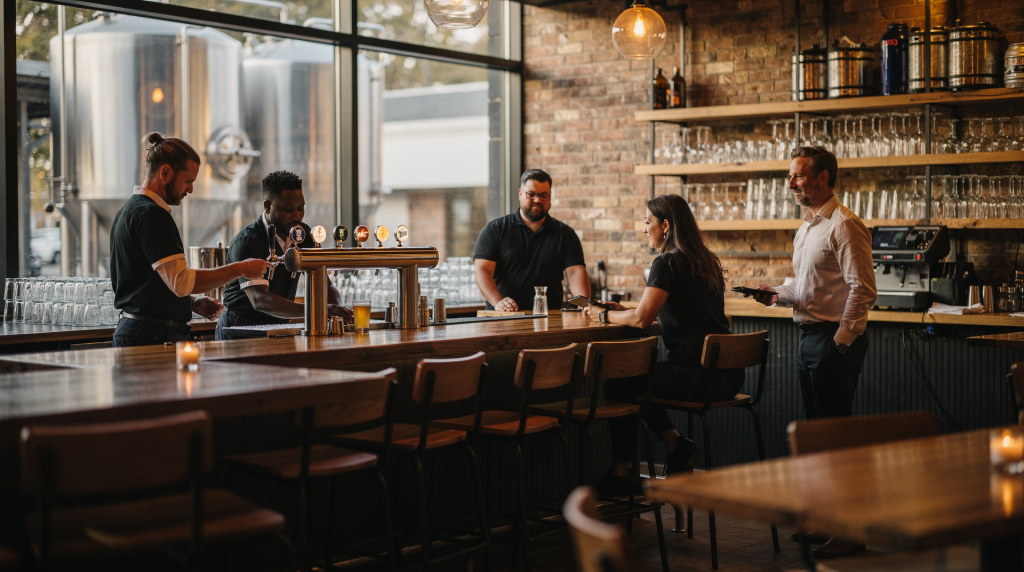
Restaurant staffing looks simple from the outside: hire good people, train them well, and keep the floor moving. In practice, the floor is where staffing either holds together or falls apart. A brewpub teaches that lesson fast because every weak link shows up in the guest experience, ticket times, and team morale. But here’s what most operators don’t connect until they’ve signed a lease: the space itself is a silent partner in your staffing equation. A poorly laid-out floor will chew through even the best team, while a smart footprint makes average staffing look competent.
Why the Brewpub Floor Changes How You Think About Staffing
A brewpub is a pressure test for staffing because it combines dining room service, bar service, production awareness, and constant guest interaction. Unlike a low-touch concept, the team cannot hide behind a narrow menu or a single service style. If the floor is short, untrained, or poorly coordinated, the entire business feels it immediately.
That is why staffing is not just a hiring problem. It is a systems problem. The floor exposes whether roles are clear, whether the layout supports the team, and whether managers are solving the right bottlenecks before they turn into service failures. I’ve watched operators blame their staff for slow service when the real culprit was a bar positioned 40 feet from the service well, forcing bartenders to log miles just to pour a beer. That’s not a people problem — that’s a space problem wearing a staffing mask.
The Core Staffing Lesson: Coverage Matters More Than Headcount
One of the biggest mistakes operators make is assuming that “enough people on the schedule” means the shift is covered. In reality, staffing works only when the right positions are covered at the right time. This becomes painfully obvious in spaces where the lease forced compromises — maybe the kitchen is on a different level, or the bar was squeezed into a corner to maximize seats for the landlord’s pro-forma.
A strong floor has balance:
- enough servers to maintain attention at peak volume
- enough support staff to keep resets and table turns moving
- enough bartending coverage to prevent the bar from becoming the service choke point
- enough management presence to solve problems before they spread
When one role is missing, the others absorb the workload. That usually creates slower service, more errors, and higher turnover. In spaces with poor sightlines or awkward station breaks, this imbalance gets amplified. A server covering a section split by a structural column or a weird alcove is essentially working two disconnected zones — and your labor model needs to account for that.
What the Floor Teaches About Turnover
Restaurant turnover remains one of the industry’s biggest staffing challenges, and recent reporting shows the problem is still serious even when conditions improve. Full-service restaurants have been cited around the low-70% annual turnover range, while quick-service concepts can run above 100% annually. In mid-2026, more operators still ranked recruiting and retention among their top concerns, even as some turnover metrics improved.
That matters on the floor because turnover is not an abstract HR issue. It affects:
- service consistency
- training quality
- manager bandwidth
- guest satisfaction
- labor cost per cover
When a brewpub loses experienced floor staff, it does not just lose labor. It loses memory: who knows the regulars, which menu items sell together, where bottlenecks happen, and how to recover when the rush spikes. But here’s the real estate layer: high-turnover spaces often share physical characteristics. Cramped server alleys, hot kitchens with poor ventilation, bars that force constant reaching and twisting — these environmental stressors accelerate burnout. I’ve seen two identical concepts with identical pay scales have wildly different retention rates, and the difference was always the physical space. One had a logical flow; the other fought its staff every shift.
Staffing Problems Usually Start Before Service Starts
Most staffing issues are visible before the first drink hits the table. The warning signs are usually in the schedule, the pre-shift huddle, and the physical setup. When I walk a space during lease negotiations, I’m already mapping where these friction points will live.
Common early warning signs:
- hosts are already behind before doors open
- servers are carrying too many sections
- food runners are asked to do too many other jobs
- bartenders are handling service tickets and walk-up guests at the same time
- managers are constantly stepping in to patch basic execution
If those patterns repeat, the issue is not just “busy nights.” It usually means the labor model is too thin for the actual guest flow. But dig deeper: is the host stand positioned where they can see the door and the floor simultaneously? Are service stations placed so runners don’t collide with servers? These spatial details determine whether your staffing model works or just looks good on paper. A space with poor flow will always demand more labor than a well-designed one — something your lease negotiations and buildout budget need to anticipate.
Floor-Based Staffing Lessons Operators Learn the Hard Way
1. Cross-training is useful, but it is not a substitute for real coverage
Cross-training can help a team stay flexible, but it cannot replace proper staffing levels. If everyone knows a little about every role, you still need enough people to execute each role well. In spaces where the kitchen is separated from the dining room by a long corridor or a flight of stairs, cross-training hits physical limits fast. A server who can run food is great — unless the expo station is a 90-second round trip from their section.
Good cross-training should do three things:
- reduce panic when someone calls out
- improve communication between FOH and BOH
- let the team adapt to different dayparts
It should not become an excuse to run permanently short.
2. Predictable scheduling matters more than heroic flexibility
In restaurant labor, schedule predictability is a retention tool. Operators increasingly focus on workflow and staffing efficiency rather than just cutting labor to the bone. Industry coverage in 2026 also points to staffing efficiency, retention, and smarter workflows as major priorities for restaurants trying to protect revenue and service quality.
On the floor, this translates into a simple truth: if employees cannot predict their hours, they leave. And when they leave, the remaining team pays for it in stress and overload. This is especially true in spaces with challenging layouts — when the physical environment already demands extra effort, schedule instability becomes the final straw. I’ve watched talented bartenders walk away from good money because the combination of a poorly designed bar and unpredictable shifts made every service feel like survival.
3. The best staff are often lost to bad systems, not bad pay alone
Pay matters, but bad systems push people out faster than most owners expect. Common friction points include:
- unclear station responsibilities
- last-minute schedule changes
- weak onboarding
- inconsistent manager communication
- unresolved tip or payout questions
- no path to grow into better shifts or roles
That is why retention improves when operators make the basics easier. Predictable schedules, better onboarding, and clearer advancement paths reduce everyday friction and improve the work environment. But I’d add one more: a space that respects the work. When servers have a clear path to their tables, when bartenders have a well-designed well, when bussers aren’t navigating a maze — those physical dignities signal that the operator values the team. In lease negotiations, the square footage you sacrifice for proper service flow isn’t lost revenue; it’s retention infrastructure.
A Simple Way to Evaluate Your Floor Staffing
Use this framework to judge whether your staffing plan is actually working. But as you go through it, ask yourself: is each “no” a people problem, or is the space making the job harder than it needs to be?
| Question | What “yes” looks like | What “no” looks like |
|---|---|---|
| Are the right roles covered? | Hosts, servers, support, bar, and manager coverage match demand | One role is repeatedly overloaded |
| Is the schedule predictable? | Shifts are posted early and stay stable | Constant swaps and last-minute changes |
| Is onboarding structured? | New hires have a repeatable first-week process | Training depends on whoever is available |
| Can the team recover from a callout? | One absence is manageable | One absence breaks service |
| Does the layout support the staff? | Clear paths, smart station placement, low traffic conflict | Staff are constantly crossing paths |
| Are managers coaching or just reacting? | Managers prevent problems early | Managers spend shifts firefighting |
The Hidden Staffing Cost of a Bad Layout
A floor layout can make staffing look better or worse than it really is. If servers have to walk too far for expo, if the bar blocks service flow, or if bussers are forced into traffic bottlenecks, the team burns time on movement instead of service. In commercial real estate terms, this is where the landlord’s desire for maximum rentable square footage collides with operational reality. I’ve seen too many leases where the operator accepted a deep, narrow space because the price per square foot looked attractive — only to discover the layout demanded an extra body on every shift just to cover the distance.
That means the wrong space can create the illusion of a staffing problem. In reality, the operator may simply be asking too much of the team design.
Watch for:
- long travel distances between kitchen, bar, and dining room
- blind spots where guests wait too long
- too many stations with poor sightlines
- narrow aisles that slow resets
- POS placement that causes congestion
The lesson from the floor is blunt: staffing and space are linked. A well-run team can only do so much in a badly designed room. When you’re evaluating a potential lease, calculate the steps, not just the square feet. A 2,000-square-foot rectangle and a 2,000-square-foot L-shape with a narrow neck are completely different staffing propositions — even though the rent might be identical.
What Better Staffing Looks Like in Practice
Strong staffing does not mean perfect staffing. It means the system can absorb pressure without breaking. In spaces where the layout works with the team instead of against it, this threshold is easier to reach. The buildout dollars you spend on smart station placement, adequate aisle width, and logical flow between FOH and BOH pay for themselves in labor efficiency.
A healthy shift usually includes:
- clear pre-shift responsibilities
- realistic section assignments
- one person accountable for guest flow
- one person watching pacing and recovery
- backup plans for callouts or sudden rushes
- a manager who is visible, not buried
That setup creates consistency. Consistency is what protects both the guest experience and the staff experience. And consistency starts with a space that doesn’t sabotage the people working in it.
Practical Checklist: Before You Open the Doors
Use this quick staffing checklist before service:
- confirm every critical station is filled
- review expected covers and reservations
- identify the busiest time window
- assign one person to monitor pacing
- verify support staff know their reset rhythm
- check that new hires are not isolated on hard stations
- make sure managers know the backup plan for a no-show
If three or more items on this list are weak, the shift is probably underbuilt. But also ask: are the “hard stations” hard because of volume, or because the physical layout makes them difficult? A station tucked behind a structural column, a section with no sightline to the kitchen, a bar well that forces the bartender to turn their back on guests — these are spatial problems that staffing alone cannot fix.
Common Mistakes Brewpub Operators Make
Overloading strong employees
The best people often get the biggest sections, the hardest shifts, and the most recovery work. That can work for a while, but it burns them out first. In spaces with poor flow, the strongest employees absorb even more of the physical burden — extra steps, awkward reaches, constant navigation around bottlenecks. They’re the first to leave, and they take institutional knowledge with them.
Treating training as a one-time event
Training has to be repeated, simplified, and role-specific. A single orientation session is not enough for floor consistency. This is especially true in spaces with quirks — that one table where the kitchen door swings close, the blind corner near the bar, the POS that’s awkwardly positioned. New hires need to learn the space, not just the menu.
Hiring for desperation
A fast hire is better than an empty shift, but bad fits cost more over time. Poor attitude, weak communication, and unreliable attendance spread quickly in a service team. When the space is already challenging, a bad hire amplifies every physical friction point.
Ignoring manager capacity
If managers are constantly covering gaps, they cannot coach, control quality, or improve retention. That creates a cycle where staffing problems never get fixed at the root. And here’s the real estate connection: managers who are stuck on the floor can’t step back and see the spatial patterns. They can’t notice that the Saturday bottleneck always happens at the same service station intersection, or that a simple reconfiguration of the bussing station would save two labor hours per shift.
The Big Takeaway for Restaurant Operators
The brewpub floor teaches that staffing is not about filling slots. It is about designing a shift that can perform under pressure. That means matching labor to demand, building predictable schedules, training for flexibility without relying on it, and paying close attention to how the space itself affects work.
When the floor runs well, guests notice the calm. When it does not, they notice everything else. But here’s what I want operators to carry into their next lease negotiation: the staffing budget starts the moment you sign for the space. A cheaper rent on a poorly laid-out footprint will cost you more in labor, turnover, and lost revenue than a slightly higher rent on a space designed for service flow. Run the numbers on both sides of the equation. The right space isn’t an expense — it’s the foundation your entire staffing strategy rests on.
FAQ
What is the biggest restaurant staffing mistake?
The biggest mistake is assuming headcount equals coverage. A shift can look fully staffed and still fail if the wrong roles are missing. But the second-biggest mistake is ignoring how the physical space distorts your staffing needs. A layout that forces extra movement, creates blind spots, or separates key stations will always demand more labor than a well-designed footprint.
Why is restaurant turnover so hard to control?
Turnover is driven by several factors at once: schedule instability, weak management, unclear growth paths, and workload pressure. Pay matters, but it is not the only issue. The physical environment plays an underrated role — cramped, poorly ventilated, or awkwardly laid-out spaces accelerate burnout and push good people out the door.
How can a brewpub reduce staffing stress?
By using clear role assignments, predictable schedules, structured onboarding, and a floor layout that supports service flow instead of fighting it. When you’re in lease negotiations or planning a buildout, invest in the spatial details that reduce daily friction: adequate aisle width, smart station placement, logical relationships between kitchen, bar, and dining room.
Does cross-training reduce staffing problems?
Yes, but only as a support tool. Cross-training helps with flexibility and coverage, but it does not replace enough people on the floor. And cross-training hits physical limits fast in spaces with poor flow — no amount of versatility can overcome a layout that demands too many steps or creates constant traffic conflicts.
What should operators watch most closely on busy nights?
Coverage balance, pacing, and manager visibility. If one role starts carrying too much of the shift, service quality usually drops soon after. Also watch where people are walking. If you see servers taking the same inefficient path over and over, that’s not a training issue — it’s a layout issue that’s costing you labor every single shift.